CardSense
Basketball guide
Basketball Card Values: What Are Your Cards Worth?
Basketball is the most parallel-driven major card market. One rookie can exist in dozens of versions with wildly different prices.
Direct answer
Basketball card values depend on the player, rookie status, the exact parallel, and condition. Modern NBA sets print the same card in many versions. Identifying the precise parallel is the job. Real value is what buyers recently paid for that version in the same condition.
What makes basketball cards different
Since the 1990s, NBA sets have layered scarce chase cards on top of base sets: refractors, colored parallels, serial-numbered versions, case hits. The gap between a base card and its rarest parallel is enormous. The five general factors still apply; see the sports card value guide.
Basketball card values by era
| Era | Years (approx.) | What it means for value |
|---|---|---|
| Vintage | 1948-1985 | Sparse releases, low survival. Early Topps and Fleer star rookies sit at the high end. |
| Insert boom | 1986-1998 | Jordan-era hobby explosion. Base is often cheap; scarce inserts of stars still chase. |
| Modern parallels | 1999-today | Engineered scarcity. The parallel and the autograph are the price. |
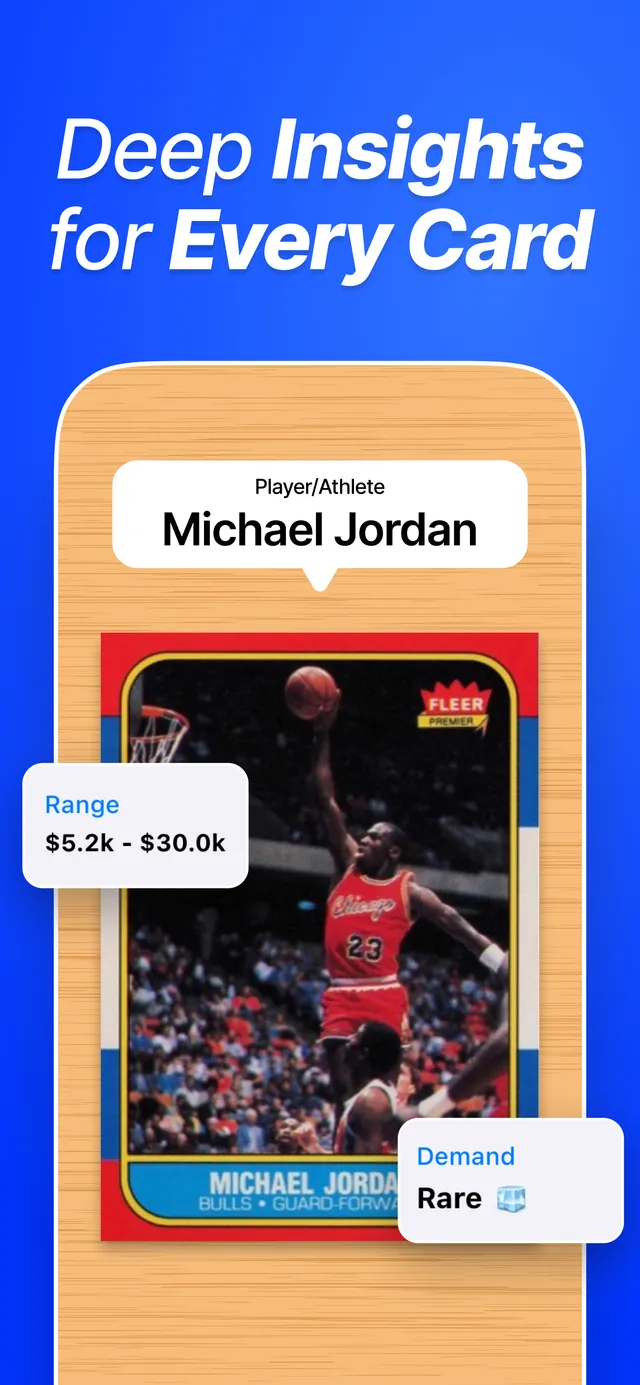
Inserts from the 1990s vs modern parallels
1990s basketball taught the hobby that a pack-odds chase card can outrun a base rookie. Many of those inserts are still the cards people mean when they say a 90s basketball card is "worth something." The trap is the base set from the same year, which was printed like wallpaper.
Modern NBA collecting flipped the script toward parallels of the same rookie. The photo may match. The print run does not. Color, foil, and a serial stamp are the whole identification job. If you skip them, you will search the wrong sold listings every time.
How to check an NBA card from a photo
Fill the frame so borders and foil are visible. Confirm the set line on the back against whatever the scanner returns. Then read the estimate as a range, not a promise. International stars often have demand from more than one country, which can make comps noisier, not cleaner.
For a binder, scan rookies and anything that looks like a parallel first. Leave base commons for last. Details on the camera flow live on the basketball card scanner page.
International demand and thin comps
NBA cards travel. A European or African star can have collectors at home and in the US looking at the same parallel, which sometimes tightens a market and sometimes just adds messy foreign listings to the sold feed. When the range is wide, open two or three actual sales and see whether you are looking at the same grade and the same parallel.
Vintage basketball is thinner. Early Topps and Fleer star rookies are the high end because so few copies survived in high grade, not because every 1970s basketball card is a grail. Most of a mixed box from that era will still be commons once you name the set. Name it first, then decide whether condition is even worth an argument.
If you are pricing to sell, pull comps from the last 60 days when you can. A Jordan-adjacent insert from the 90s can have a long tape. A current parallel of a role player may have three sales and a prayer. The range is the honest output. A single screenshot of someone else's asking price is not.
Sources
FAQ
Basketball FAQ
Are basketball cards from the 1990s worth anything?
Base cards from the early 1990s were overprinted and are usually cheap. The exceptions are scarce inserts and premium sets of superstars, plus iconic rookies in top graded condition.
Why are two basketball cards of the same player worth different amounts?
Modern sets are built around parallels: colors, foils, and print runs from unnumbered base to 1/1. The exact parallel, plus condition, is what separates a common from a chase card.